

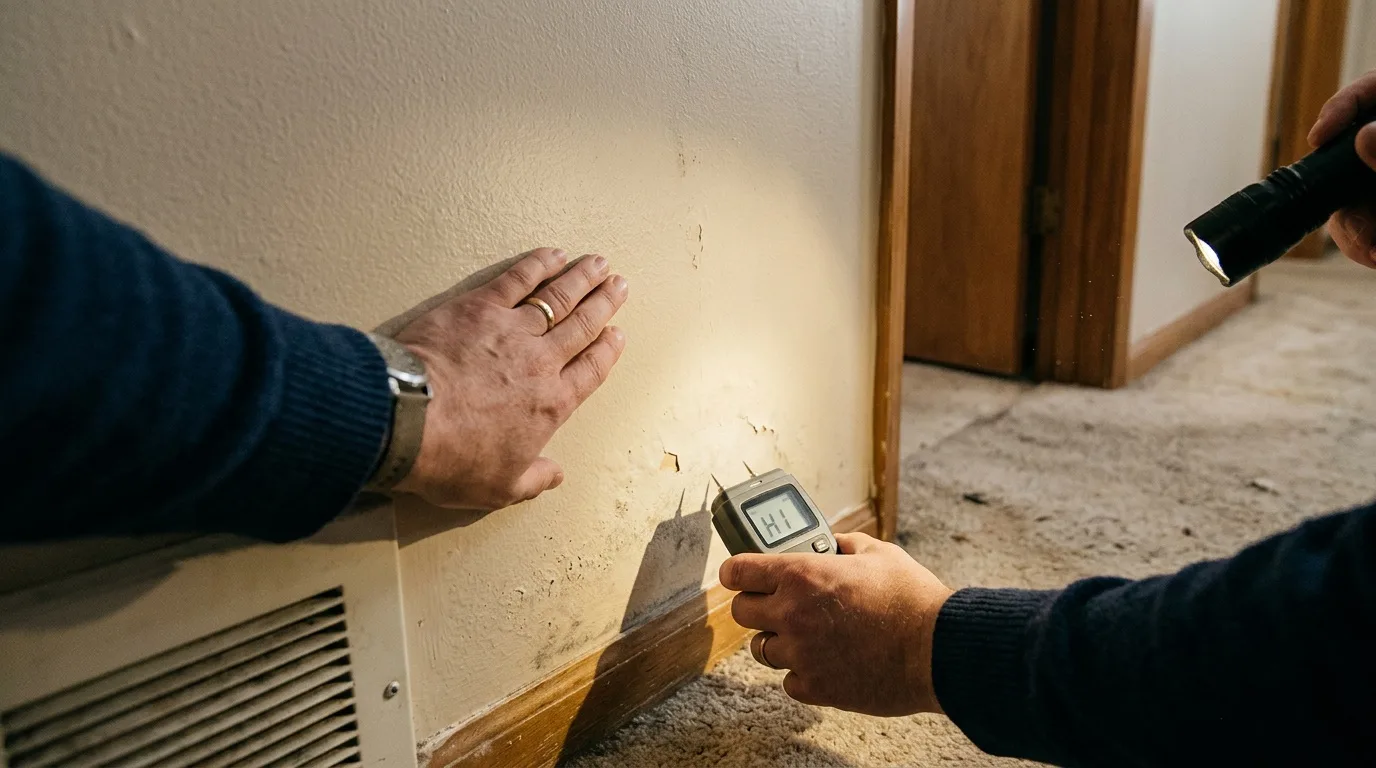
People usually start dealing with mold after they see it. It doesn't always happen that way. Spores can hide inside walls, under wallpaper, behind furniture or in ventilation. Mold behind drywall can grow for a long time before anything shows on the room side, and a small spot on the surface may be only part of the problem.
Below: how to suspect mold in walls, where it usually starts, what a moisture reading tells you, when the wall has to be opened, and why the work means little unless the water is stopped.
What Mold Is and Why It Ends Up in a Wall
Mold is a microscopic fungus that grows on just about anything. That may sound like an exaggeration, but take any material and mold will be there, from the leaves of a houseplant to the grain in a pantry and every pinch of soil. Molds give off microscopic seed-like particles called spores, which travel through the air. There are so many of these spores that you breathe them in all the time.
When the spores land on a surface, they germinate and form long threads that branch out into spider-like colonies, growing into round patches. After a few days of growth, the colonies start producing a new generation of spores.
Mold can grow in any building. It grows wherever water collects, but in buildings it becomes a real problem only with a constant plumbing leak or in a flooded home. So yes, water damage can cause mold in walls, and drywall is one of the first materials to suffer. Drywall, wallpaper, paint and wood all soak up moisture easily and become food for mold. Mold breaks down cellulose and destroys binders. Moisture gets into brick, concrete and plaster, causing cracks and peeling. Wet insulation loses its insulating value.
Mold in Walls Signs You Can Check From the Room
Visual signs
Inspect the surfaces (corners, ceilings, areas behind furniture, windows, plumbing fixtures and pipes) and look for:
- Dark spots - black, gray, green, white or pink.
- Spots that appear after rain or a leak.
- A loose or fuzzy film on the surface.
- Streaks, stains, bubbling wallpaper and peeling paint.
- Cracks in plaster with darkening around them.
- Discolored paint or plaster.
- Swollen baseboards along a wall that has been wet.
Problem growth shows up, for example, when drywall gets soaked through and the colonies turn into large brown or black patches.
The smell
Mold has a typical "earthy" smell that comes across as damp and musty, and it is hard to get rid of. It is noticed most often when you walk into a room or when the windows are closed. A mold in walls smell that does not go away is one of the reasons to call for a professional check.
Mold in walls symptoms in people
Mold can also be suggested by:
- Chronic runny nose, stuffy nose.
- Morning cough or a scratchy throat.
- Eye irritation, skin rashes.
- Unusual tiredness, headaches.
- Worse allergies and asthma.
Children, older people, people with asthma, allergies or a weakened immune system are especially vulnerable.
Where Mold Behind Drywall Usually Starts
Mold can appear almost anywhere there is moisture, poor ventilation and an organic surface. The most common spots:
- Under the sink and behind kitchen cabinets.
- Wall sections near the stove (because of steam).
- Joints between tiles and shower enclosures.
- Behind the washing machine and under the bathtub.
- Transitions between cold and warm zones, which in a house usually means exterior walls.
- Corners with no air movement, for example corners blocked by furniture.
Even in the cleanest homes there may be traces of mold under bathroom and kitchen sinks. Important: if mold keeps coming back, look for a deeper cause. The fungus may not simply "settle" in separate spots of the living space but "live" in the structure of the house or in its systems (ventilation, heating, waterproofing).
Moisture Meters and Other Checks
You can set up a hygrometer: if it shows humidity above 60%, that is a warning sign. A hygrometer reads the air, though, not the wall. Professional services measure moisture in the air and in the structure itself, with a meter for the moisture content of the material.
A moisture reading answers one question - is the wall wet. It does not show the mold itself. Photographs taken before and after any work help describe the problem more precisely, but they do not replace an inspection and do not show moisture deep in the structure. One photo and the color of the growth are not enough to say with confidence what kind of fungus it is or what state the whole room is in.
Air testing and what it can't prove
With heavy mold growth, you can hire an indoor air quality specialist to measure the concentration of spores in the air of the house. During testing, the specialist takes air samples inside and outside the house on the same day. If the spore level indoors is much higher than outdoors, mold is most likely growing somewhere inside the house.
There is a limit to this. According to the EPA's page on mold testing and sampling, there are no EPA or other federal limits for mold or mold spores, so sampling cannot be used to prove that a building "passes." If mold is already visible, sampling is usually unnecessary.
Is Mold Behind Drywall Dangerous?
Indoor mold causes three problems. First, it is unsightly and smells bad. Second, airborne spores can trigger asthma, allergic rhinitis or hay fever. Finally, some kinds of mold produce toxic chemicals called mycotoxins. How much they affect people indoors is still being studied, and the concern is greatest in badly flooded homes.
The mold called Stachybotrys is often called toxic black mold. This fungus grows on drywall when the drywall gets soaked with water, and it gives off a number of mycotoxins. Black mold spores are sticky and have a hard time getting into the air. That limits how many spores people nearby can breathe in, so the dose of toxins from indoor mold is usually small. But the developing lungs of infants and young children are especially vulnerable to damage. That is why it matters to limit mold growth in homes and remove the moisture sources that feed it.
When to Open the Wall
If the moldy area is smaller than about 10 square feet, roughly 3 by 3 feet, the EPA says a homeowner can usually clean it. With heavier growth, the drywall often has to be removed and replaced. If mold has spread over a large area or goes deep into building materials, trying to get rid of it yourself can be useless and even dangerous. Professional work is needed when:
- Mold covers more than about 10 sq ft.
- The fungus comes back after cleaning on your own.
- Mold shows up inside the structure - on framing, under the floor, under the slab.
- A damp smell stays in the house and does not go away.
- There are ventilation problems you cannot fix yourself.
- Someone in the family has asthma, allergies or a weak immune system.
For homeowners in Alpine, the details of that work are on the mold remediation services page.
Removal: Porous Drywall Is Replaced
Preparing the area
- Find and stop the moisture source (for example, leaking pipes). Without this step you will never get rid of the mold for good.
- Ventilate: open windows, turn on the exhaust fan.
- Take out furniture, curtains, rugs, and cover the remaining surfaces with plastic. Belongings that have to leave the room for the duration can go through pack-out and contents storage.
- Remove wallpaper, paint and plaster if they are damaged.
- Dry the surface.
Mold releases spores and toxins that can cause serious health problems. Always use a respirator (not a medical mask, but a filtering one - an N95 or better), heavy rubber gloves, and long-sleeved clothing that can later be washed hot or thrown away if the contamination was heavy. After the work, wash your hands thoroughly and air the room out.
Disinfection and repair
- Treat the walls again after the main removal.
- Use a detergent solution, a diluted bleach solution (never mixed with ammonia or other cleaners) or a household mold cleaner.
- Remove porous and damaged sections - plaster, drywall, insulation.
- If mold has reached concrete or brick, clean down to the solid base.
- Before repairs, seal the surfaces with a mold-resistant, stain-blocking primer.
- Use moisture-resistant materials, for example paints with antifungal additives.
Typical mistakes
- Treating over wet walls.
- Using the wrong products.
- Finishing the treatment too fast.
- Skipping the repeat treatment.
- Ignoring re-sealing or repairs.
Do not paint over the area before it has been checked.
Stopping the Moisture
Treatment does not repair a pipe, a siding joint or a vent duct. Even if the affected surface has been cleaned, the cause of the dampness that remains can again create conditions for mold growth. Either way, fixing the plumbing leak or protecting the house from flooding is necessary to keep mold from coming back.
So it is worth splitting this into two questions: how the damage was removed, and what was done about the water getting in. If the house went through a flood, find out whether the structure has dried out - a separate article covers dehumidifiers for structural drying, and the larger jobs belong to water damage restoration. For a bathroom, air exchange and leaks are looked at separately.
A general household tip rarely replaces diagnosis. More frequent airing out, for example, will not stop water coming in through a damaged joint. And extra drying without stopping the leak will not finish the problem.
If spots come back after treatment
The wall looked clean after treatment, but later dots appeared on it again. From that alone you cannot tell what went wrong. Damaged material may have been left on the surface, the wetting may have continued, and new spots sometimes appear in a neighboring place. Did the growth return within the old borders, or did it show up farther away? Did it happen after rain, after the weather turned cold, after a new leak? Is the wall damp all the time or only in certain conditions?
A record like this is more useful than "the fungus got stronger." It helps tell repeated wetting apart from a question about how much was cleaned the first time. A promise to "remove all spores forever" does not describe a task an ordinary treatment can do. The practical goal is a fixed cause of dampness, cleaned or replaced materials, and no new growth with further watching.
More on the people who do this work in the area is on the about our restoration team page and in what local customers wrote. Other articles are collected in the restoration news and guides section, and the main services are listed on the company home page.