

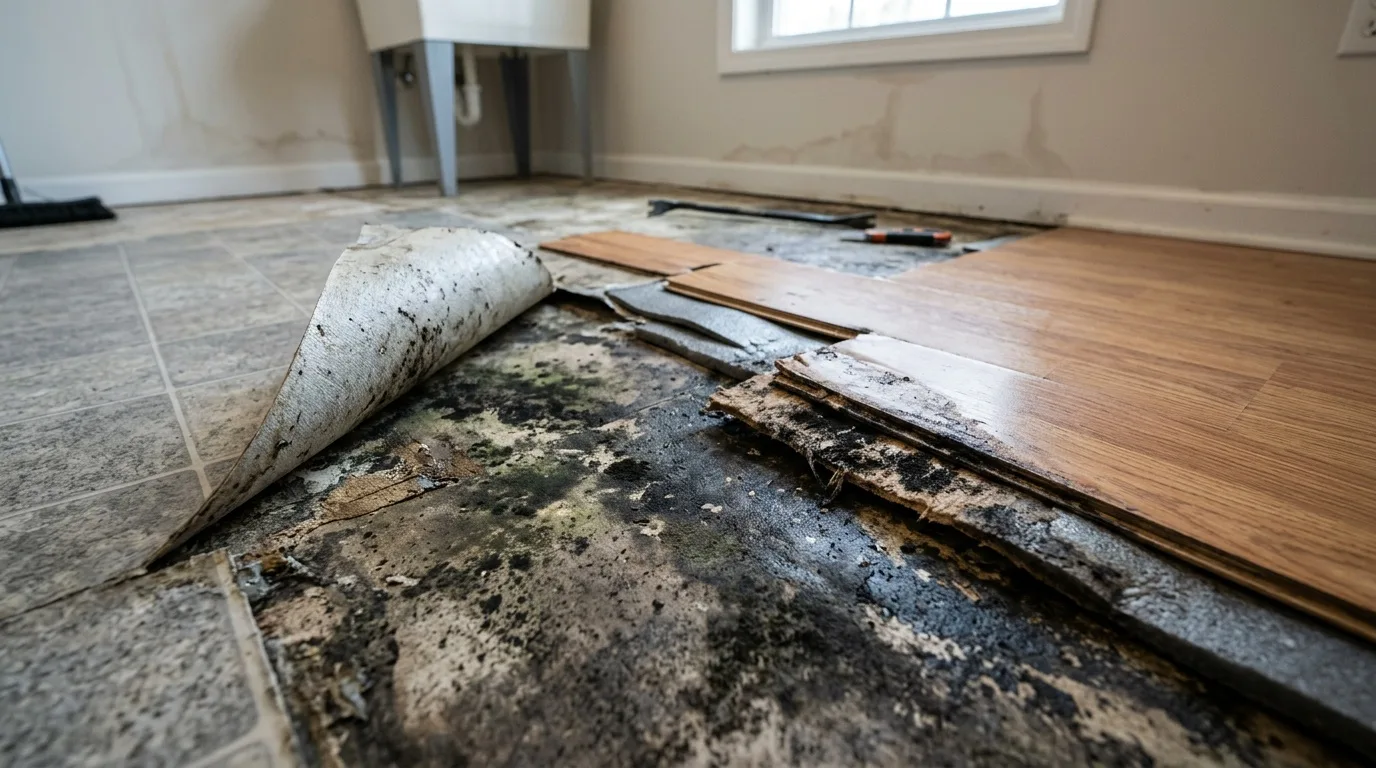
Mold can be waiting for you in any corner of a home, and the worst part is that owners of houses and apartments very often do not even suspect it is there. Mold under vinyl flooring is one of the most common problems in homes where no renovation has been done for a long time. When the time comes to replace the floor covering, it turns out that a harmful microorganism has been living with you for years. The question of how to remove mold under vinyl or laminate then becomes very pressing and needs a quick and simple answer.
Under unfavorable conditions mold spores start multiplying actively. At first mold on the floor forms in the corners of rooms and under the baseboards. Gradually the fungus spreads around the whole perimeter, and a specific damp smell appears. Below are the reasons it happens, how to tell it is there, and what helps get rid of it, whether the floor is vinyl, sheet vinyl or laminate. If the damage is already large, the mold remediation services in Alpine page describes how the work is done professionally.
Why Mold Grows Under Vinyl and Laminate
In most cases the cause of fungus is high humidity and a lack of ventilation. Such conditions can form through improper cleaning or leaking pipes. Water can collect in the corners after mopping and get deeper through cracks in the covering. This is how mold attacks hardwood and shows up under laminate, sheet vinyl, vinyl and other coverings.
One of the downsides of vinyl is that it lets out neither moisture nor air. That is, if moisture has already got under the covering, it will stay there. And moisture is exactly the reason mold forms under it.
There are quite a few reasons for mold under the floor. It is worth noting that mold takes hold in many conditions and can live even at "untypical" temperatures and humidity levels, so practically nobody is safe from it. In practice these causes come up most often:
- A mistake during installation. When laying vinyl, the floor must be dried first so that concentrated moisture does not stay there for years. This trap waits for those who poured a concrete base or self-leveler. The covering was laid on new concrete that had not dried yet, and the result is moisture under the covering, then fungus and mold.
- Poor isolation of the floor from moisture. This is common in houses on a slab. With correct installation, a vapor barrier goes down between the concrete and the floor. Every effort has to be made so that moisture does not come up through the floor, otherwise mold may appear. The floors are not insulated, or the waterproofing is poor, and moisture comes in from below.
- A room that is too damp and has no ventilation. Bathrooms and kitchens suffer a lot from fungus and mold. Moisture soaks into literally everything, the flooring included. Mold under vinyl flooring in a bathroom is a typical case. Poor ventilation plus low temperatures (heating that is not good enough) does the same.
- A problem with plumbing. Even a few drops a day can cause mold under the floor. Leaks of water supply and drain lines all count. Listen to the plumbing and inspect it regularly; this may prevent mold in the future.
- A wooden base that was already affected. The covering was laid on a wooden surface, the wood (floor boards, plywood, joists) was already affected by fungus, and no antiseptic treatment was done.
- A damaged covering. Possibly the vinyl is damaged, for example by furniture: there are tears and cuts in the surface, you wash the floors and water gets under it.
- Poor-quality installation in general.
With laminate the causes are first of all connected with humidity in the room. Possibly you washed the floors using a lot of water, or pipes, faucets or valves are leaking. Water from a burst line or an appliance is a separate story, and the water damage restoration process covers what happens to floors after that kind of event.
Signs of Mold Under the Floor
A typical situation: laminate was laid a couple of years ago and everything seemed to be fine. Now a mold smell has appeared in the room, and judging by everything the mold is under the laminate. A musty smell from the floor is often the first and only sign, because you will not know about mold under the covering until the problem becomes serious.
What to look out for:
- A persistent damp smell. It can stay even after the room has dried. After a basement or a ground floor is flooded, the water level can hold for several days, and even after it dries a stubborn damp smell appears and mold spots come through on the walls and on the floor.
- Spots in the corners and under the baseboards. This is where mold on a laminate floor or on vinyl usually starts, before spreading around the perimeter.
- Mold under a wooden baseboard. To make sure there is no mold, it is worth checking the space under a wooden baseboard from time to time.
- Dark seams. Black or gray lines along the joints between planks or tiles.
- Cupping and lifting. Laminate planks that curl up at the edges, swell or feel soft underfoot, and vinyl that bubbles or lifts.
Checking Where the Moisture Comes From
Start with the plumbing nearest the spot: the dishwasher, the refrigerator water line, the toilet, the sink. If nothing leaks and the floor sits on a slab, moisture may be coming up through the concrete: tape a square of plastic sheet to the bare slab for a day or two; drops under it mean moisture from below. If the fungus develops around the whole perimeter, the problem is poor ventilation.
Possibly the laminate was laid in a hurry on a slab that had not fully dried. A slab should dry fully (the flooring maker's instructions say how dry), and only after it has fully dried is laminate laid. As for the mold smell, there is no way around it: both the mold itself and the source (cause) of it have to be removed.
Removing Mold Under Vinyl, Sheet Vinyl and Laminate
Mold under laminate or hardwood is the hardest to remove. In some cases the old covering has to be taken up completely and the floor redone. What to do depends on the situation, but in any case the vinyl has to be removed completely, and after removal it is better thrown away, all the more so if it is damaged. Affected laminate is simply thrown away. Without replacing the covering it will not be possible to get rid of the mold for good.
Work on a small area can be done on your own, but with all precautions and in a certain order. The process should be split into several stages, with the room prepared first:
- Remove the furniture. First take all the furniture out of the room being treated. If mold is found on clothing and household items, get rid of them or disinfect them. For larger rooms full of belongings, pack-out and contents storage keeps things out of the work area.
- Isolate the room. The room being treated is completely isolated from the other rooms. To do this, close the doors and cover openings to the rest of the house with plastic; a fan in an open window, blowing out, keeps spores from drifting inside.
- Fix the leak first. At the start eliminate the cause of the leak, for example have a plumber fix the faucet or the pipes.
- Take off the baseboards and the covering. Remove the baseboards around the perimeter of the room. Take the covering (laminate, hardwood, vinyl, carpet) off the affected areas, then wet it with water (this keeps spores from spreading through the air), put it into trash bags, tie them tightly and haul them away. If there are many affected areas, it is recommended to remove the covering completely.
- Clean off the mold mechanically. With a scraper, wire brushes or putty knives remove the mold spots (work in gloves and a respirator). A concrete floor must be cleaned of the deposit mechanically before treatment.
- Remove the dust and dirt, then treat the floor.
Work with bleach only in rubber gloves and with protective equipment (a respirator), and never mix bleach with vinegar, ammonia or other cleaners. Open windows and turn on ventilation, because mold spores will rise into the air while you scrape.
What to Treat the Floor With
Home remedies that have proven themselves well:
- Baking soda;
- Vinegar;
- Chlorine bleach;
- Citric acid;
- Borax.
Many people deal with mold under vinyl and laminate using bleach. The active chlorine in it disinfects and helps remove the problem. However, this treatment cannot be used for prevention: under unfavorable conditions the mold comes back. The bleach is diluted with water as the label directs, because finishing materials change color after undiluted bleach.
A vinegar solution is also often used against fungus. It is safe if you use the same protective equipment and ventilate the room well. But keep in mind that even a weak acid can damage some lacquer finishes. Where the mold problem is not that big, you can pour vinegar on it and rub with a cloth. If the mold is deep, you need a scrub brush.
Antifungal products sold in home improvement stores are another option. When choosing how to treat the floor, pay attention to the type of covering so as not to ruin it, and read the instructions on the label carefully before using a product. For more general guidance, the EPA's advice on mold cleanup at home is a good reference.
Mold Under Vinyl Flooring on Concrete
If the vinyl was laid on concrete, it is easier to clean. If the mold has gotten into the concrete, use a 10:1 water to bleach solution, adding 1/4 cup of trisodium phosphate for every 2 gallons of water used. Rub this solution into the concrete to clean it. If that does not help, use a small amount of trisodium phosphate again. Give the concrete time to dry completely before laying new flooring.
The lasting fix is stopping the moisture that comes up through the slab, which a flooring installer measures before any new floor goes down.
Mold on a Wooden Subfloor
Tear up and throw away the old covering and inspect the wooden floor. If it is in very bad condition, you need to consider laying a new one. If the base under the vinyl is particleboard or plywood, it is also better to remove it and throw it away.
If the floor can be saved, wash it with a detergent solution. To get rid of mold in all the cracks, mix water and bleach in a 10:1 ratio. This cleans the mold to a deeper degree. If that is not enough, try a 4:1 ratio, adding 1/4 cup of trisodium phosphate for every 2 gallons of water. Use a long-handled brush to get deeper. Then let the wood dry completely. Sand the treated areas (wearing a respirator), and also other areas that became discolored. Remove all the sawdust.
Treatment, Primer and Drying
The antifungal product is applied with a sponge, brushes or paint brushes. After the first coat wait as long as the label says and treat the surface again. At the end scrape the surface once more and then simply rinse it with water. The product goes not only on the floor but also a few inches up the walls.
After drying, prime the floors with a mold-resistant primer. It can be applied with a roller or a brush. The floor must dry fully before anything goes on top; drying out a slab or a subfloor is slow, and the guide to dehumidifiers used for structural drying explains what equipment is used for that.
Reinstalling the Floor With a Moisture Barrier
After the treatment and drying, new laminate or vinyl can be laid. Follow the installation rules and the recommendations the manufacturers state. On a concrete slab, laminate and most vinyl planks go over a vapor barrier, usually a 6-mil plastic sheet or an underlayment with one built in, as the flooring maker requires. Where you plan to lay new vinyl, find the source of moisture again before you do. Make sure the base is in good condition first.
None of the products gives a 100% result, and how reliable a product was can only be checked over time. The best protection against mold coming back is a dry slab and a proper vapor barrier.
Prevention
Removing the mold alone is not enough; the cause has to be dealt with as well. That means paying attention to the ventilation system, to the insulation of the building and to the heating. There should be no elevated humidity in the rooms.
- Ventilate the rooms as often as possible.
- Do not let moisture collect, especially in the corners.
- Keep indoor humidity below 60%, ideally 30–50%.
- Check the ventilation. At a minimum clean the exhaust vents and check the gaps between doors and the floor.
- Test the slab first. Before a new floating floor goes on concrete, have the slab checked for moisture and use the barrier the flooring maker requires.
- Fix leaks fast. Leaks under sinks, dishwashers and toilets show up under the floor long before they show on top.
- Do not wet-mop laminate. Use a damp mop and wipe up spills.
- Dry the floor after any repairs, and only then lay the covering.
More articles on water, mold and fire damage are collected on the restoration news and tips blog. You can also read what Alpine homeowners say, learn about our restoration team, or go back to the home page with all services.