

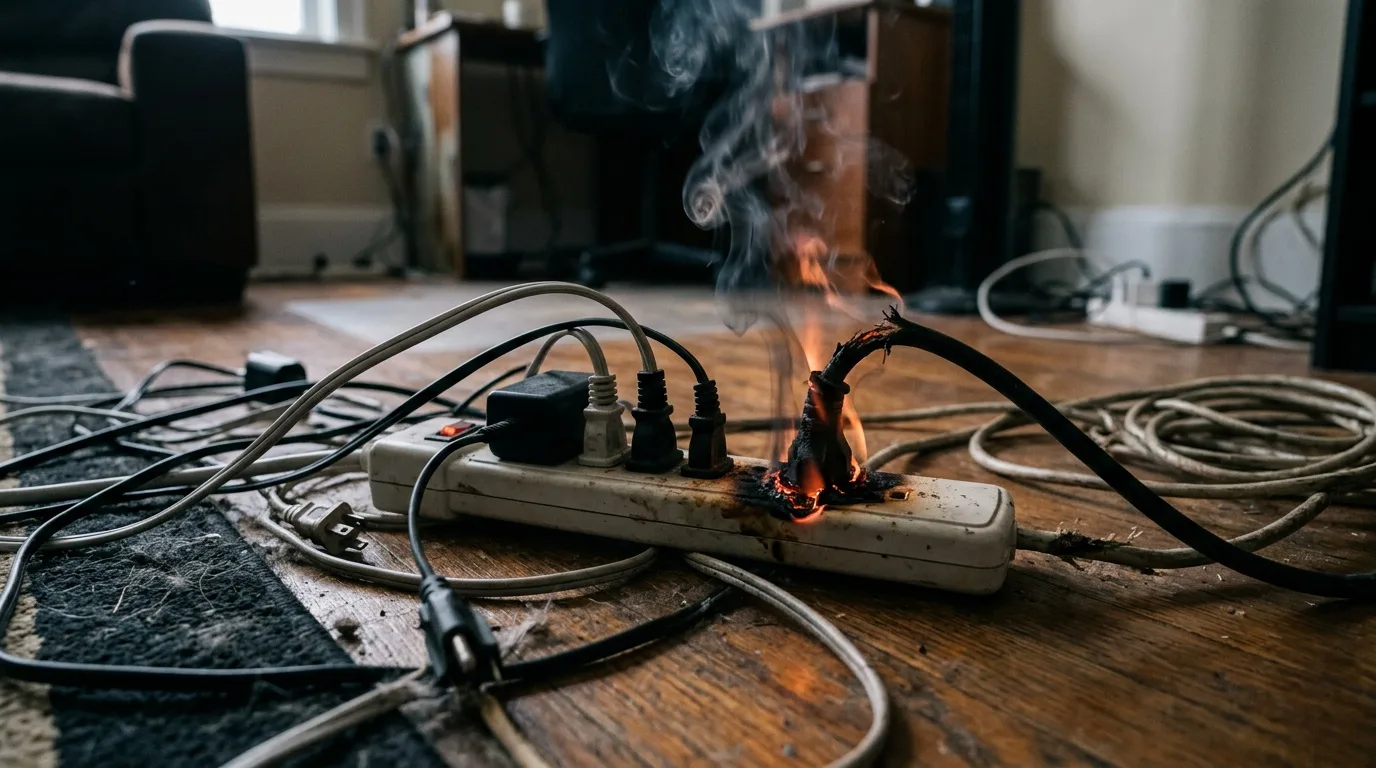
Extension cords seem reliable. You lay one on the floor, plug in everything you need, and the shortage of outlets is solved. But these are exactly the things that often become the source of a fire. Overheated wires, melted plugs and the smell of burning — firefighters know these scenarios far too well.
A standard household outlet in the US sits on a circuit built for 15 A at 120 V, which is about 1,800 W of load. Extension cords and power strips, though, are limited by the thickness of their wire. Cheap thin cords carry much less than that, and even the heavier ones leave a minimal margin. That is why the power strip fire hazard is real even in a house with good wiring.
Below is what makes a cord or power strip overheat, which appliances should not go into one, and what to watch for. Many people have used their cords this way for years without thinking about it.
Why an Extension Cord Catches Fire: Overloading
Every extension cord and every power strip has a total power rating. The load plugged into it must not go above that limit. For example, take a five-outlet strip rated for 1,800 W. You can plug in a 900 W waffle maker and a 900 W coffee maker, but the other three outlets should stay free, because the waffle maker and coffee maker running at the same time already give the maximum load. And if you add a 500 W mixer, the cord of the strip will start to literally melt. That can easily start a fire.
What protects you? The breaker in the electrical panel. When the circuit is overloaded, it should cut power to the outlet the cord is plugged into. However, the breaker does not always trip, because the breaker and the extension cord are rated for different maximum currents. So the homeowner has to keep track of how much power goes into the cord.
Where the contact is poor — in a cheap cord, or when the plug is not pushed all the way in — high resistance appears. The wire starts to heat, the insulation melts, and a fire can break out. An uncertified cord with high contact resistance can overheat even with a single lamp plugged into it.
Older cords are also often not built for today's load. With a heater, several chargers or other devices plugged in, the total current can go over the limit, and the cord begins to heat up from the inside.
Daisy-Chaining Power Strips
Never link extension cords to each other when one is not long enough. Plugging one power strip into another is dangerous because of the risk of power strip overload and fire. A cord does not add power; it only divides one point of connection between more devices. Each link in the chain adds another set of contacts that can heat up.
Heaters and Other Heat Appliances: Straight Into the Wall
Extension cords are made for temporary connection of low-power devices: floor lamps, phones, laptops, printers, fans. Do not plug into an extension cord anything that heats, turns a motor or needs grounding.
Space heaters
In winter many homes use them: oil-filled radiators and convection heaters warm a room well, and fan heaters make it comfortable in a couple of minutes. But this same power turns them into a hazard. A typical heater draws about 1,500 W, which is practically the limit for a standard outlet. An extension cord, especially a cheap one or one wound on a reel, is not built for that current.
With long hours of work at this power, the cord and contacts overheat faster than you notice. The result is melted plugs, blackened plastic and a real risk of fire. Heaters should be plugged only directly into their own wall outlet.
Toaster ovens, countertop ovens and hot plates
A small oven seems like a good solution for a kitchen without full-size appliances. It takes almost no space, runs from an ordinary outlet and, thanks to its high power, does the same job as built-in units. The same goes for compact portable induction and older coil hot plates. For these kitchen helpers, high wattage is normal, while many household cords are rated for much less. So from the first minutes they run at the limit of the wiring. If a kettle or a microwave is plugged into the same strip, it is a lost cause. Over an hour or so of work, the cord heats up almost as much as the appliance itself. Such devices must be plugged into a fixed wall outlet, with no cords and no adapters.
Electric kettles
Kitchen appliances that heat are a common cause of fires, and kettles are among them. Every start is a sharp jump in load, which for an extension cord means hot contacts. If the family is large and everyone likes tea, dozens of such cycles add up in a day — the cord may not even have time to cool down. Paired with a microwave or a hot plate on one strip, the risk goes to the maximum. The simplest solution is to give the kettle its own outlet in the kitchen.
Irons
While heating up, an iron draws a lot of power, and the extension cord carries almost the same load as the iron's own heating element. The contacts in the cord's socket heat up, gradually lose their reliability and can scorch. Working conditions add danger: long cycles of holding temperature, random tugs on the cord while ironing, and the risk that the iron tips over right onto the wire. The only safe option for an iron is a separate outlet on the wall.
Motors, Kitchen Appliances and Electronics
- Refrigerators and freezers. When the motor of a refrigerator or air conditioner starts, power draw jumps well above the rated value for a split second. A refrigerator also runs around the clock. If it is plugged into a poor cord, that cord will heat constantly. Over time the contacts loosen, and smoldering begins.
- Washing machines. This workhorse runs for hours unattended, and heating water gives a peak load. Moisture makes it worse: in a laundry room or kitchen there is always a risk of water reaching the cord or connector. A washer is better plugged straight into a grounded outlet, preferably on its own circuit with its own breaker — and better still with GFCI protection.
- Dishwashers. This is a full household unit with heaters, pumps and electronics. It works for hours on long cycles. The cord usually ends up squeezed behind cabinets with no ventilation and no one watching it, close to water.
- Portable air conditioners and dehumidifiers. The compressor start comes with a sharp jump in load, and these units run not for hours but for days on end. At some point the pleasant cool in the room can easily turn into the smell of burning plastic.
- Microwaves. The transformer and magnetron inside pull a lot of power and start with a sharp surge of current. With many short starts a day, that chronic load becomes a strength test for the cord. A microwave and a kettle switched on at the same time on one strip easily push the total over the limit, and the wiring starts to heat.
- Computers, TVs and audio equipment. Cheap cords have poor contacts and no noise filtering. They can give voltage dips that kill computer power supplies and distort sound in audio equipment.
Many modern refrigerators and washing machines have a three-prong grounded plug. Extension cords are often sold without grounding, which removes protection against electric shock.
Surge Protector vs. Power Strip
A surge protector and a power strip both connect appliances to an outlet, but they are not the same thing. A power strip is just an extension of the outlet. A surge protector is a protective device. The differences:
- Surge protection. A surge protector is often equipped to protect connected devices from voltage spikes in the line. A plain power strip usually has no such protection.
- Short-circuit protection. Some surge protectors cut power automatically when a short circuit occurs. A power strip usually does not have this function.
- Noise filtering. Surge protectors can have filtering that improves the quality of power and keeps interference from other devices. A power strip can't do this.
- A switch. Surge protectors have a switch on the body to cut power to all connected devices at once.
- Price. Surge protectors usually cost more because of the extra protection.
For a computer or home theater, a quality surge protector or a UPS is the exception — it is no longer just an extension cord. But not every model has all of these features, and a surge protector still does not raise the power limit. Heaters and other heavy loads go into the wall either way.
Damaged Cords and Cords Under Rugs
Damaged insulation raises the risk of a short circuit, including at night when everyone is asleep. An old extension cord with damaged insulation, or one of doubtful quality, should be replaced.
A cord warms up while it works, and normally the heat goes away into open air. That is why it is especially dangerous to keep a cord under a rug or next to a bed: the heat has nowhere to go, the insulation wears faster, and over time the wire can be exposed. Overheating there can lead to a fire. Do not run cords under rugs, through doorways or near heating appliances, and do not hide them behind furniture. They need to cool and should always be in sight.
A reel-type cord should always be unwound completely. If you plug a powerful appliance into a reel without unwinding it, the cable stays coiled. In that state it can't cool — the heat of the working wire builds up inside the coil. The wire overheats, the insulation melts, and a short circuit can happen.
Signs of Overheating
Walk around the house and check the cords — some of them may already be melting. Stop using the connection if you notice:
- A warm cord or plug. A cord that feels hot while working is carrying more than it should.
- A burning smell. The smell of hot or burning plastic near a strip or behind furniture.
- Melted or blackened plastic. Darkened areas around the plug, a deformed housing, a softened cord.
- A breaker that trips often. This means the setup of what is plugged in where needs to be checked.
Rules for Using Extension Cords Without Risk
Extension cords are not dangerous by themselves — the problems start when we use them for the wrong job. If you can't do without one, at least follow these simple rules:
- Temporary only. Remember that an extension cord is a temporary solution, not a replacement for wiring.
- Read the rating. Check the allowed current marked on the body of the cord or strip. At 120 V, 13 A is about 1,560 W and 15 A is about 1,800 W.
- One powerful appliance, one outlet. Don't move hungry neighbors into the same strip.
- Thick and short. Where possible, use cords with a thick, short cable — less heating and less voltage drop.
- No wet areas. Kitchens and bathrooms should have GFCI-protected outlets instead of cords.
- Read the manual. From an ordinary instruction manual you can learn, for example, that a stove must not be used to heat a room, or that heating appliances must not run without a stand made of non-combustible material.
- Unplug at night. Do not leave extension cords switched on overnight without need.
The U.S. Fire Administration electrical safety sheet is a short printable list of the same basics.
After a Small Electrical Fire
Make sure your home has smoke alarms. Smoke alarms have saved more than one life, and their absence has cost whole families. The alarm tells you the room is filling with smoke and can wake a person at night.
A home should also have fire extinguishers, and it is worth remembering that they are different. Having an extinguisher is not enough — you need to know how to use it, practice, and teach children to get out and stay out.
Never use water or a water-based extinguisher on an electrical fire. If it is safe, unplug the appliance or turn off the breaker and use an extinguisher rated for electrical fires (Class C, such as an ABC unit). If the fire does not go out at once, get everyone out and call 911.
Even a small fire at a power strip leaves soot, smoke odor and melted plastic on walls, floors and nearby belongings, and the water used to put it out can soak into flooring. What happens next is described in our fire damage restoration timeline for Alpine homes. For cleanup of soot and smoke, see our fire damage restoration services; if water soaked the room, there is also water damage restoration for wet rooms. Belongings from the affected room can be packed out and cleaned separately — read about contents pack-out and cleaning.
You can learn who we are and how we work, read reviews from local homeowners, or browse more home safety articles on our blog. Everything else is on the Alpine restoration company home page.
Even following all of these points, don't forget the main rule. To avoid a fire, unplug appliances you aren't using. It doesn't take much time, but it keeps you and the people around you safe.