

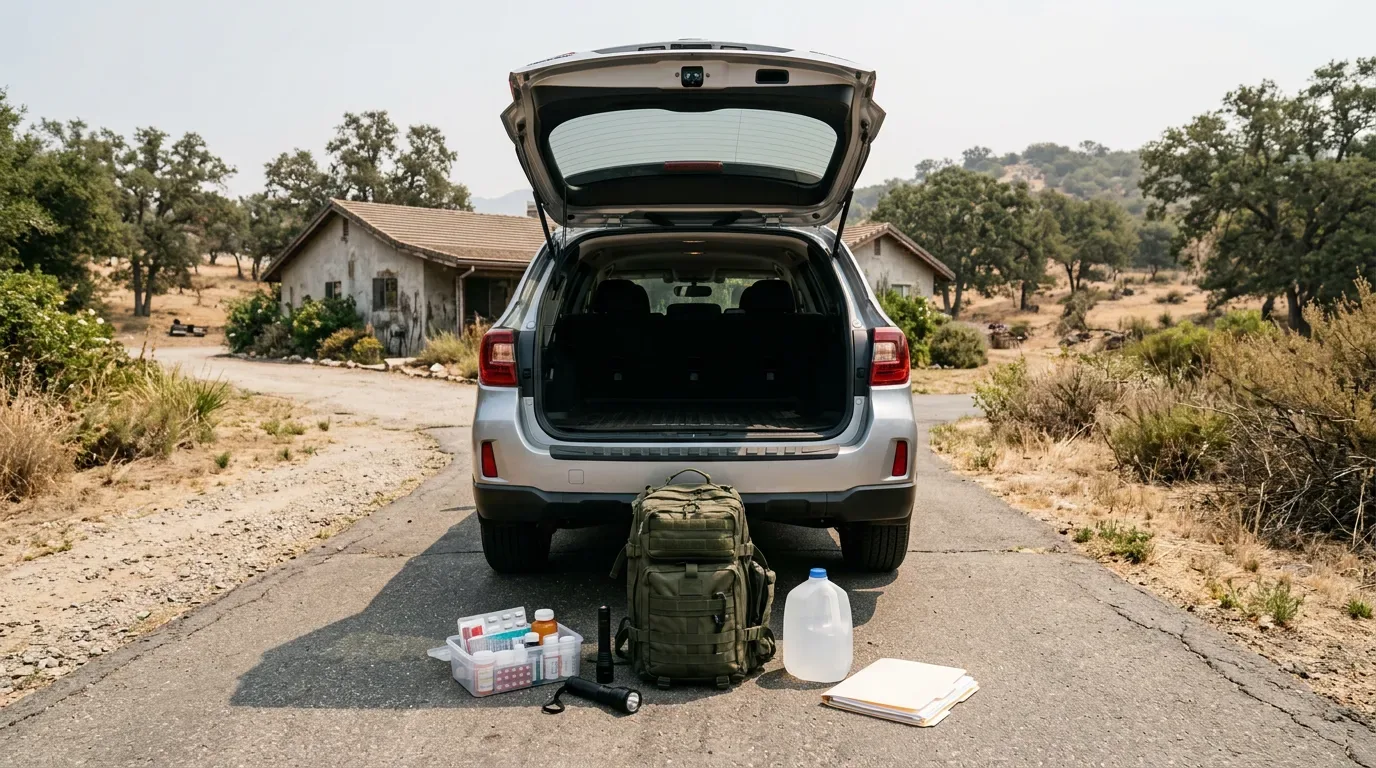
When you evacuate, the first things to take are documents, money, your phone with a charger and a power bank, the medications you take every day, a first aid kit, drinking water, shelf-stable food, clothing and shoes for the season, hygiene items, a flashlight, a respirator, work gloves, and the things you need for children, older relatives and pets. Documents, money, medications and electronics are best packed in waterproof bags.
A universal list only works when there is time to pack. If there is a direct threat to life, you need to leave right away. Do not stay behind for a suitcase, electronics, clothes or other belongings.
What goes into a wildfire evacuation kit depends on the season, how you will travel, and the health of each family member. If you leave by car, you can take more. If you have to leave on foot, the backpack has to be light enough to carry on your own for a long time. Below is a wildfire evacuation checklist for Alpine households, put together from evacuation guides, with notes on documents, medications, pets, the car and the house itself.
If you are told to leave immediately, do not pack a suitcase. Take the children, help anyone who cannot move well, take the pet if you can do it at once, grab your phone and vital medications if they are close by, and leave by the route you are given. Life matters more than documents and property.
Before Fire Season: Alerts and a Plan
Things do not replace a plan worked out in advance. In San Diego County, AlertSanDiego recommends registering cell phones for county emergency alerts and keeping an evacuation go-kit. CAL FIRE's Go! evacuation guide says to keep the Go Bag packed and ready, keep your wildfire action plan current, and know your evacuation routes.
Your family should know:
- Alerts: which official alert channels to use.
- The bag: where the backpack is kept.
- Roles: who takes the documents, who is responsible for the child, who helps the older relative, who takes the pet.
- Meeting places: where to meet if you lose contact with each other.
- Routes: the main route and a backup route.
- Check-in: who to tell that you have left.
Pick two meeting places: one near the house and one outside the area. One contact person can live in another city or state. Through them it is easier for family members to pass on news when local lines are overloaded.
The Go Bag List
A go bag is a backpack packed in advance and kept at home for an emergency. A sturdy bag with a shoulder strap or a backpack keeps your hands free. The more pockets and compartments it has, the easier it is to organize. A suitcase on wheels only suits a smooth road and leaving by car.
Basic wildfire go bag contents:
- Phone and power: phone, charging cable, power bank, a paper list of contacts.
- Chargers: spare chargers for every device you take, or one charging station with several ports. Pick cables a couple of yards long.
- Power bank: with fast charging and several ports. In an evacuation shelter there may not be enough outlets for everyone, and a power bank saves time waiting in line.
- Light: a flashlight and spare batteries. A very powerful one is not needed indoors; a headlamp or a crank flashlight that needs no recharging is practical.
- Signals and news: a whistle and a radio, if you have one.
- Water and food: CAL FIRE's Go Bag list calls for a three-day supply of non-perishable food and three gallons of water per person. Keep most of it ready in the car; in the backpack itself, a bottle or two of water and food that needs no cooking, such as protein bars and crackers, plus a cup, a spoon and a can opener.
- Clothes: clothing and shoes for the season, underwear, socks, a warm sweater, a rain poncho, a hat. Pack three sets of socks, underwear and T-shirts.
- Protection: work gloves and a respirator or other recommended protective gear.
- Hygiene: toothbrush, toothpaste, razor, soap, shampoo, comb, toilet paper, wet and dry wipes, a towel, and pads for women. Pack it all in a separate pouch; a synthetic pouch and towel dry faster.
- Small tools: a sturdy folding knife, matches or a lighter, a needle and thread, a notebook and a pen for filling out forms.
- Other: trash bags, a bag for wet clothes, a blanket or an emergency thermal blanket.
For a wildfire, add closed clothing that covers the body, a hat, heavy gloves, safety glasses and sealable bags. Do not wear exposed synthetic clothing to walk through a smoky area.
If you only have a few minutes, the order is:
- People and pets.
- Documents and necessary medications.
- Phone and means of communication.
- Water and clothing for the weather.
- Everything else, only if you can take it without delay.
Leave at home appliances, the TV, heavy books, large amounts of clothing, glassware, furniture, perishable food, gas cylinders, flammable liquids and unknown chemicals. CAL FIRE's short list of what to grab, the six P's, does include a personal computer or its hard drive, irreplaceable pictures, and cards and cash. Do not take things that can slow you down, injure other people or create a fire hazard.
Documents and Digital Copies
Gather documents into a separate folder in advance. Take the originals you do not use every day and copies of the rest:
- IDs: driver's license, passport, Social Security cards.
- Family papers: children's birth certificates, marriage certificate.
- Insurance and health: health insurance cards, medical records, prescriptions, disability and benefits documents.
- Property: documents for the car and the house.
- Other: veterinary records and photos of family members.
Put the documents in a waterproof folder or a sealed bag, in an inside pocket of the backpack, away from the water bottle and the food. Do not put the whole family's documents in an outside pocket that is easy to unzip or damage.
Make paper and electronic copies. Electronic versions can be kept on the phone, on a protected drive, in cloud storage, in email, or with a trusted relative. A photo of a document does not always replace the original, but it can make it easier to restore one that is lost. Do not keep all documents only on the phone: a phone can run out of charge.
Medications
A supply of your own medications is one of the top priorities. A regular first aid kit does not replace individual treatment. Take:
- Supply: medications for several days, plus a small reserve in case of delay.
- Paperwork: prescriptions, the doctor's instructions, a list of doses.
- Supplies: devices for giving the medication and the consumables they need.
This matters most for people with diabetes, asthma, epilepsy, heart conditions, severe allergies, thyroid disease, mental health and neurological conditions, and other chronic illnesses. Some medications need to be kept cold; talk with your doctor ahead of time about how to transport them and get a suitable insulated container. Ask your doctor what to do with doses if your schedule changes.
If someone has a chronic condition or an allergy, make a separate card with their name, date of birth, diagnoses, allergies, medications, doses and times, how they move and communicate, and contacts of relatives and their doctor. Keep the card in the first aid kit, the wallet, a coat pocket, or the backpack of the person who goes with them. For a child, an older or less mobile person, make several copies.
Pets
Put together a separate set:
- Gear: carrier, leash, harness, a muzzle if needed, an ID tag.
- Papers: vet records, copies of vaccination records, a photo of the animal.
- Care: food, water, a bowl, medications, waste bags, pads, a towel.
Label the carrier and gear. It helps to get the animal used to the carrier, the leash, car rides and being around people ahead of time. A frightened pet can run off or hide, and is hard to hold in your arms, so do not let it out without something secure. Ask how pets are handled at the evacuation shelter; sometimes there is a separate area for them.
Getting the Car Ready
Put in the car:
- Essentials: documents, first aid kit, water, food, warm clothes.
- Power and light: flashlight, charger, power bank.
- Car items: tire inflator, tow strap, work gloves, spare washer fluid.
Check the fuel level, tire pressure, battery charge, the route, road closures and the official destination. Do not block traffic or the way for emergency services. Do not drive into smoke, into the fire zone, under damaged structures or onto closed roads. If officials send people along a set route, do not take a "shortcut" through the danger area. The official route takes into account information that ordinary people do not have.
Do not rely only on the car, either. The car may not be available, the road may be closed, and traffic may stop.
Leaving Early
Packing from scratch after the alert is one of the most common mistakes: time goes into looking for documents and medications. If the go bag is ready, you only need to add the original documents and medications. Do not look for things when you do not know where they are.
Other mistakes worth knowing:
- Going back for valuables. In a fire this can cost a life.
- Taking too little water. The route and the wait can take longer than planned.
- Not preparing a child. A child gets scared, runs off or tries to go back for a toy.
- Following rumors. Unverified information can send people into the danger zone.
- Changing the route on your own. The wind and the direction of the fire can change quickly.
- Tying up phone lines. Many long calls make it harder for emergency services to communicate.
Check the backpack several times a year: food and medication dates, water, the power bank charge, batteries, documents, relatives' phone numbers, children's clothing sizes, pet food. It is convenient to do this when the seasons change. Put a sheet inside with the date of the last check.
Preparing the House Before You Leave
Only if it is safe and does not delay an urgent evacuation:
- Utilities: shut off the gas if officials or your gas utility advise it, turn off electrical appliances, shut off the water, put out the stove or fireplace.
- Openings: close all windows and doors, as CAL FIRE advises, and take your keys.
- People: warn the neighbors, help children and older people, put on suitable clothing.
Do not spend time on cleaning, packing furniture, searching for valuables, saving appliances, loading the car for a long time, or taking photos of your belongings. If an official instruction for your situation says to leave windows, doors or vents a certain way, follow it.
Coming Home: Ash and Smoke Damage
Do not go back to the house after an evacuation without official permission. Do not try to drive through a wall of smoke or flames, and do not go into areas that are still closed.
A house that is still standing can still have ash and smoke damage inside. Our fire damage restoration in Alpine page explains what that work covers, and the fire damage restoration timeline guide walks through the stages. If belongings need to be taken out and stored, see contents pack-out and storage services. Water used to fight a fire can soak into the house too, which falls under water damage restoration services.
You can read more about our Alpine team, see what local homeowners say in reviews, browse more articles on our blog, or go back to the Alpine restoration home page.